Tuesday, September 9, 2014

F-35B Lightning II


Roles

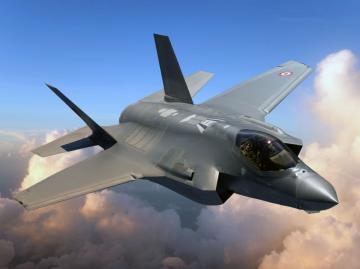
The F-35B Lightning II will place the UK at the forefront of fighter technology, giving the Royal Air Force a true multi-role all weather, day and night capability, able to operate from well-established land bases, deployed locations or the Queen Elizabeth Class Aircraft Carriers.

Specifications

  • Engines: Pratt & Whitney F-135-600
  • Thrust: 40,000lbs
  • Max speed:1.6Mach
  • Length: 15.6m
  • Max altitude:50,000ft
  • Span: 10.7m
  • Aircrew: 1
  • Armament: Paveway IV, AMRAAM, ASRAAM

The Lockheed Martin F-35 Joint Strike Fighter will be known in UK service as the Lightning II. Lockheed Martin is the prime contractor but the UK is the only Level 1 partner with the US. A number of British companies, including BAE Systems and Rolls-Royce will have significant industrial work-share in construction and development of the aircraft. The Lightning II will provide UK Defence with a 5th Generation (low observable, supersonic, enhanced data fusion), multi-role, all weather, day and night aircraft that will have the ability to operate from land bases as well as the Queen Elizabeth Class carriers, the first of which is due to accept Lightning II onto her deck in 2018. This basing flexibility will give UK Defence a truly joint expeditionary Combat Air capability well into the 2030’s. The RAF is the lead service for the operation of Lightning II and, like the Harrier before, the Joint Lightning II Force will be manned by both RAF and RN personnel.Future Armament: Storm Shadow, SPEAR, METEOR, 25mm Gun Pod
Lightning II has been designed from the outset to carry out a wide range of mission types, able to use its very low observable characteristics to penetrate Integrated Air Defence Systems and strike a number of types of targets. In a permissive environment, Lightning II is able to carry weapons on external pylons, as well as in the internal weapon bays. This will allow a maximum weapon payload of 6 Paveway IV, 2 AIM-120C AMRAAM, 2 AIM-132 ASRAAM and a missionised 25mm gun pod.
The Lightning II design applies stealth technology manufacturing techniques and, to minimise its radar signature, the airframe has identical sweep angles for the leading and trailing edges of the wings and tail, and incorporates sloping sides for the fuselage and the canopy.
The advanced sensor suite of the Lightning II is the greatest step-change in capability that the UK has not previously possessed. The APG-81 is an Active Electronically Scanned Array multi-function radar with Synthetic Aperture Radar and Ground Moving Target Indication capabilities. Targeting information can also be supplied by an Electro-Optical Targeting System, which provides long-range detection and precision targeting by employing thermal imaging, laser tracking and marking. 360 degree situational awareness is aided by the Electro-Optical Distributed Aperture System. Lightning IIs advanced mission systems will also provide navigation information, missile warning and infrared search and track capabilities.
Lightning II will place the RAF at the forefront of fighter technology and will give it a true multi-role aircraft that will surpass the majority of other weapons systems in production today, or envisaged in the foreseeable future. Lightning II and Typhoon aircraft will make up the Fast Jet elements of Future Force 2020.
The UK has taken delivery of its first 2 Lightning II aircraft which, together with a number of military personnel, are stationed at Eglin AFB, Florida. In 2014, the personnel and aircraft will transition to Edwards AFB, California, to begin Initial Operational Test and Evaluation.

Islamic State may have taken anti-tank weapons from Syrian rebels


Anti-tank weapons that were likely once owned by moderate Syrian rebels have landed in the hands of Islamic State militants, according to a newly released field investigation conducted in both northern Iraq and Syria.
The Islamic State has also captured “significant quantities” of U.S.-manufactured small arms and has employed them on the battlefield, researchers found.
The investigation, led by a small-arms research organization known asConflict Armament Research, marks a rare attempt to physically document the weapons being used by the Islamic State, the radical group that has expanded its control in parts of Syria and Iraq.
Militants with the group have picked up significant caches of arms after seizing Iraqi and Syrian military installations. The new research suggests they have also amassed arms after overrunning the moderate Syrian rebels being supplied by the United States and other allied nations.
To catalog the arms, field researchers embedded with Kurdish forces in Iraq and Syria for 10 days toward the end of July and were allowed access to Islamic State weapons that were captured after clashes. Along with the anti-tank weapons, manufactured in the former Yugoslavia, researchers documented a handful of U.S. M16A4 rifles, two Chinese Type 80 machine guns, a Croatian sniper rifle, a 9mm Glock pistol and various Soviet-era small arms.
In one case, U.S.-made weapons were found by the Kurdish forces near Ayn al-Arab, Syria. The weapons were likely obtained by the Islamic State after it conquered the northern Iraqi city of Mosul, roughly 300 miles away, according to field investigator Shawn Harris.
“They are transporting these weapons in batches, and have a solid organizational approach to moving these weapons around,” Harris said. “They’re operating as professionals.”

Turkey Orders F-35


The Defense Industry Executive Committee, the highest decision making body for Turkish Defense acquisition projects, met on 6 May 2014 and tasked the Turkish Undersecretary for Defense Industries, or SSM in Turkish, to order the country’s first two F-35A Lightning II multirole fighters. The aircraft will be delivered as part of Low-Rate Initial Production Lot 10. The SSM was also tasked to perform necessary activities for the establishment of a Final Assembly and Check-Out line and depot-level maintenance center for the F135 engine within Turkish local industry and Turkish Air Force structure. Turkey is one of the original F-35 consortium partners, joining the project in 1999. Current Turkish defense plans call for 100 F-35As.

Twelve Things To Know About The U-2

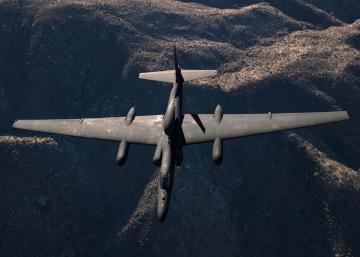
The U-2 provides peacetime reconnaissance in support of disaster relief from floods, earthquakes, and forest fires. It also supports search and rescue operations. The NASA ER-2 performs atmospheric studies.

1. Name

The official US Air Force name for the U-2 reconnaissance aircraft is Dragon Lady. This appellation can be traced to the Milton Caniff-drawn cartoon strip Terry and the Pirates that originated in the 1930s. The aircraft is often called Deuce and The Article by pilots. It has also been called Angel.

2. Basics

Empty weight: 14,300 pounds
Takeoff weight: 40,000 pounds
Wingspan: 103 feet
Length: 63 feet
Height: 16 feet (from ground to tip of tail)
Cruise speed: 475 miles per hour
Payload: 5,000 pounds; available space: 310 cubic feet
Flight endurance: twelve hours (as determined by pilot duty day)
Range: greater than 6,000 nautical miles
Engine/Thrust: General Electric F118-GE-110/17,000 pounds

3. Operating Locations

Beale AFB, California (1st Reconnaissance Squadron: pilot and maintenance training; 99th Reconnaissance Squadron); South Korea (5th Reconnaissance Squadron; Cyprus (eastern Mediterranean region); Southwest Asia (99th Expeditionary Reconnaissance Squadron); Palmdale, California (flight test, upgrades, and programmed depot maintenance).

4. Operational Airframes

Thirty-four, including five two-seat trainers and two ER-2s operated by NASA.

5. Service Life

Most of the current fleet of U-2s was built in the late 1980s. The fleet has about eighty percent of its service life remaining.

6. Sensors, Communication, And Protection

The aircraft gathers imagery in a number of ways, including through digital imagery, radar imagery, and traditional wet-processed film. Similarly the U-2 collects signals intelligence in various frequency bands with a variety of sensors. Datalinks on the aircraft allow for immediate transmission of sensor data. The U-2 carries an electronic countermeasure system for self-defense.
The U-2 provides peacetime reconnaissance in support of disaster relief from floods, earthquakes, and forest fires. It also supports search and rescue operations. The NASA ER-2 performs atmospheric studies.

7. Sensor Locations

The aircraft features an interchangeable nose and various bays in the fuselage for carrying sensors. The aircraft can also carry two large wing-mounted pods, called superpods, and an upper fuselage pod.

8. Significant Upgrades

General Electric F118 turbofan engine (1994); Raytheon Remote Airborne Sensor, or RAS-1R, a radio frequency signals intelligence sensor (2001); Glass cockpit (2003); BAE AN/ALQ 221 defensive suite (2005); nose-mounted Raytheon Advanced Synthetic Aperture Radar System, known as ASARS-2A (2005); Dual Datalink 2 (2005); Power Upgrade (2006); Northrop Grumman AN/ASQ-230 radio frequency signals intelligence suite (2008); Cockpit Altitude Reduction Effort, or CARE (2013); United Technologies Aerospace Systems Senior Year Electro-Optical Reconnaissance System, or SYERS-2C (2014)

9. Maximum Altitude And Attaining It

The exact maximum altitude of the U-2 remains somewhat sensitive, though the US Air Force advertises the maximum altitude as 70,000+ feet. The amount of time the U-2 requires to attain initial altitude is one of its most impressive characteristics. The aircraft can climb to its initial operating altitude of 60,000 feet in about one hour.

10. Pressure Suit

The full-pressure suit, called the S1034, acts as a back-up cockpit for the pilot. The suit protects pilots from decompression sickness while they are flying or if they must eject at high altitudes. The suit inflates automatically to three and a half pounds per square inch and supplies 100 percent oxygen to the pilot when it senses a loss of cabin pressure.

11. Takeoffs And Landings

The aircraft has bicycle-style gear in the fuselage. Small wheels on a flexible shaft called pogos are attached on the wings for taxiing and takeoffs. The pogos fall off the aircraft just after the aircraft lifts off the ground. They are reattached to the wings by a ground crew after the aircraft lands. With its glider-like wing, the U-2 wants to fly. So landings are essentially controlled stalls. During landings, the aircraft is routinely chased on the runway by another U-2 pilot driving a high-performance vehicle, such as a Chevrolet Camaro. The U-2 pilot driving the chase car communicates the height above ground so the pilot in the U-2 knows when to set the aircraft down.

12. Lesser-Known Missions

The U-2 provides peacetime reconnaissance in support of disaster relief from floods, earthquakes, and forest fires. It also supports search and rescue operations. The NASA ER-2 performs atmospheric studies.

Sunday, August 31, 2014

Bangladesh Navy’s Ming Class Subs Coming


Dhaka is purchasing two submarines from China in a deal that has portends of increasing militarisation of the Bay of Bengal.  Beijing had asked for $203 million when two sides began final negotiations in November 2013, according to officials. Dhaka managed to reduce the submarines’ price by $10 million, or around Tk 80 crore, after bargaining with Beijing early this year as per a New Age Bangladesh report.
Dhaka has finally signed a deal with Beijing for the purchase of two submarines for $193 million. These submarines of Ming class will have capacity of firing anti-ship missiles from its torpedo tubes and are to be delivered in 2019 as per the New Age. Bangladesh Navy personnel are already carrying out submarine training in China as per reports.
The Ming class of Chinese submarines is an adaptation of the diesel or electric Romeo class submarine built by the Soviet Union, which in turn was based on the German Type XXI submarine of World War II. Reports indicate that Bangladesh will be purchasing the advanced version of Ming class submarine, Type 035G which has low acoustic signature with larger space for weaponry. The capability of the sub may be limited to coastal defence and surveillance possibly the task envisaged by Bangladesh Navy.
However in the medium to long term sale of Chinese Ming class submarine by China to Bangladesh will result in the induction of a new submarine power in the Indian Ocean region and more particularly in the Bay of Bengal.This sale would raise concerns given that the submarine will introduce new capability in the Bay of Bengal.  But, given that the Ming class is seen to be a vintage sub, the Bangladesh Navy may have had a bad bargain from China.
The PLA Navy however will gain an entry into the Bay of Bengal. This is because, along with the submarine there would be attendant personnel including some from the People’s Liberation Army – Navy, who would be based in Kutubdia Island where the submarine fleet will harbour.

Saturday, August 30, 2014

Sukhoi T-50 PAK FA

The T-50 is the aircraft designed by Sukhoi for the PAK FA programme. The aircraft is a stealthy, single-seat, twin-engine jet fighter, and will be the first operational aircraft in the Russian Air Force service to use stealth technology. It is a multirole combat aircraft that can be used for both air superiority and ground attack missions.
The T-50 is intended to be the successor to the MiG-29 and Su-27 in the Russian Air Force and serve as the basis of the Sukhoi/HAL FGFA being developed with India. The aircraft combines supersonic cruise, stealth, maneuverability, and advanced avionics and software to overcome legacy fighter aircraft as well as ground and maritime defenses. The T-50 prototype first flew on 29 January 2010 and the aircraft is slated to enter service in the Russian Air Force in 2016. The prototypes and initial production batch will be delivered with heavily upgraded models of Su-27 power plants as interim engines while a new clean-sheet design engine is currently under development. The T-50 is expected to have a service life of up to 35 years.
 

Role
Stealth multirole fighter
National origin
Russia
Manufacturer
NAPO, KnAAPO
Designer
Sukhoi
First flight
29 January 2010
Introduction
December 2016
Status
Flight testing/pre-production
Primary users
Russian Air Force
Russian Navy
Produced
2009–present
Number built
5 prototypes
Program cost
US$8–10 billion (est.)
Unit cost
T-50: US$50+ million
Variants
Sukhoi/HAL FGFA

Specifications (T-50)


General characteristics
·         Crew: 1
·         Length: 19.8 m (65.0 ft)
·         Wingspan: 13.95 m (45.8 ft)
·         Height: 4.74 m (15.6 ft)
·         Wing area: 78.8 m2 (848.1 ft2)
·         Empty weight: 18,000 kg (39,680 lb)
·         Loaded weight: 25,000 kg (55,115 lb) typical mission weight, 28,300 kg (62,390 lb) at full fuel
·         Max. takeoff weight: 35,000 kg (77,160 lb)
·         Powerplant: 2 × NPO Saturn izdeliye 117 (AL-41F1) for initial production, izdeliye 30 for later production thrust vectoring turbofan
·         Dry thrust: 93.1 kN / 107 kN (21,000 lbf / 24,100 lbf) each
·         Thrust with afterburner: 147 kN / 176 kN (33,067 lbf / 39,600 lbf) each
·         Fuel capacity: 10,300 kg (22,700 lb)
Performance
·         Maximum speed:
·         At altitude: Mach 2.3 (2,440 km/h, 1,520 mph)
·         Supercruise: Mach 1.6 (1,700 km/h, 1,060 mph)
·         Range: 3,500 km (2,175 mi) subsonic
·         Ferry range: 5,500 km (3,420 mi) with one in-flight refueling
·         Service ceiling: 20,000 m (65,000 ft)
·         Wing loading: 317–444 kg/m2 (65–91 lb/ft2)
·         Thrust/weight:
·         Saturn 117: 1.06 (1.19 at typical mission weight)
·         izdeliye 30: 1.24 (1.41 at typical mission weight)
·         Maximum g-load: +9.0 g
Armament
·         Guns: Provision for 1× 30 mm GSh-301 cannon in right LEVCON root
·         Air to air loadout:
·         6× K-77M or 4× izdeliye 810
·         2× K-74M2 or 2× izdeliye 300
·         Air to ground loadout:
·         4× Kh-38M or 4× Kh-58UShK or 8× KAB-250 or 4× KAB-500
·         2× K-74M2 or 2× izdeliye 300
·         Air to sea loadout:
·         4× Kh-35
·         2× K-74M2 or 2× izdeliye 300
·         Hardpoints: Six external hardpoints.
·         Kh-31
·         R-73
·         R-77
Avionics
·         Sh121 multifunctional integrated radio electronic system (MIRES)
·         N036 Byelka radar system
·         N036-1-01: Frontal X-band AESA radar
·         N036B-1-01: Cheek X-band AESA radars for increased angular coverage
·         N036L-1-01: Slat L-band arrays for IFF
·         L402 Himalayas ECM suite
·         101KS Atoll electro-optical system
·         101KS-O: Laser directional infrared countermeasures
·         101KS-V: Infrared search-and-track
·         101KS-U: Ultraviolet missile approach warning system
             101KS-N: Targeting pod