
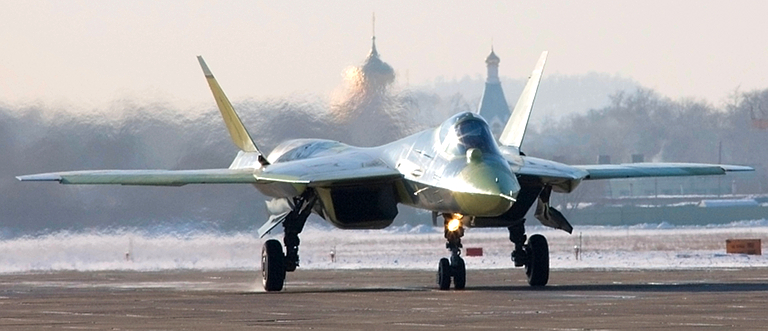
The T-50 is
the aircraft designed by Sukhoi for the PAK FA programme. The
aircraft is a stealthy, single-seat, twin-engine jet fighter,
and will be the first operational aircraft in the Russian Air Force service to
use stealth technology. It is a multirole combat
aircraft that can be used for both air
superiority and ground attack missions.
The T-50 is intended
to be the successor to the MiG-29 and Su-27 in the Russian
Air Force and serve as the basis of the Sukhoi/HAL FGFA being
developed with India. The aircraft
combines supersonic cruise, stealth, maneuverability, and advanced
avionics and software to overcome legacy fighter aircraft as well as
ground and maritime defenses. The T-50 prototype first flew on 29 January 2010
and the aircraft is slated to enter service in the Russian Air Force in
2016. The prototypes and initial production batch will be delivered with
heavily upgraded models of Su-27 power plants as interim engines while a new
clean-sheet design engine is currently under development. The T-50 is expected
to have a service life of up to 35 years.
|
Role
|
Stealth multirole fighter
|
|
National origin
|
Russia
|
|
Manufacturer
|
NAPO, KnAAPO
|
|
Designer
|
Sukhoi
|
|
First flight
|
29 January 2010
|
|
Introduction
|
December 2016
|
|
Status
|
Flight testing/pre-production
|
|
Primary users
|
Russian Air Force
Russian Navy |
|
Produced
|
2009–present
|
|
Number built
|
5 prototypes
|
|
Program cost
|
US$8–10 billion (est.)
|
|
Unit cost
|
T-50: US$50+ million
|
|
Variants
|
Sukhoi/HAL FGFA
|
Specifications (T-50)
General characteristics
·
Crew: 1
·
Length: 19.8 m (65.0 ft)
·
Wingspan: 13.95 m (45.8 ft)
·
Height: 4.74 m (15.6 ft)
·
Wing
area: 78.8 m2 (848.1
ft2)
·
Empty
weight: 18,000 kg
(39,680 lb)
·
Loaded
weight: 25,000 kg
(55,115 lb) typical mission weight, 28,300 kg (62,390 lb) at full fuel
·
Max.
takeoff weight: 35,000 kg
(77,160 lb)
·
Powerplant: 2 × NPO Saturn izdeliye 117
(AL-41F1) for initial production, izdeliye 30 for later
production thrust vectoring turbofan
·
Dry
thrust: 93.1 kN / 107 kN
(21,000 lbf / 24,100 lbf) each
·
Thrust
with afterburner: 147
kN / 176 kN (33,067 lbf / 39,600 lbf) each
·
Fuel
capacity: 10,300 kg
(22,700 lb)
Performance
·
Maximum
speed:
·
At
altitude: Mach 2.3
(2,440 km/h, 1,520 mph)
·
Supercruise: Mach 1.6 (1,700 km/h, 1,060 mph)
·
Range: 3,500 km (2,175 mi) subsonic
·
Ferry
range: 5,500 km (3,420
mi) with one in-flight refueling
·
Service
ceiling: 20,000 m (65,000
ft)
·
Wing
loading: 317–444 kg/m2 (65–91
lb/ft2)
·
Thrust/weight:
·
Saturn 117: 1.06 (1.19
at typical mission weight)
·
izdeliye 30: 1.24 (1.41 at typical mission weight)
·
Maximum g-load: +9.0 g
Armament
·
Guns: Provision for 1×
30 mm GSh-301 cannon in right LEVCON root
·
Air
to air loadout:
·
6× K-77M or 4× izdeliye 810
·
2× K-74M2 or 2× izdeliye 300
·
Air
to ground loadout:
·
4× Kh-38M or 4× Kh-58UShK or 8×
KAB-250 or 4× KAB-500
·
2× K-74M2 or 2× izdeliye 300
·
Air
to sea loadout:
·
4× Kh-35
·
2× K-74M2 or 2× izdeliye 300
·
Hardpoints: Six external hardpoints.
·
Kh-31
·
R-73
·
R-77
Avionics
·
Sh121 multifunctional
integrated radio electronic system (MIRES)
·
N036 Byelka radar
system
·
N036-1-01: Frontal
X-band AESA radar
·
N036B-1-01: Cheek
X-band AESA radars for increased angular coverage
·
N036L-1-01: Slat L-band
arrays for IFF
·
L402 Himalayas ECM
suite
·
101KS Atoll
electro-optical system
·
101KS-O: Laser
directional infrared countermeasures
·
101KS-V: Infrared
search-and-track
·
101KS-U:
Ultraviolet missile approach warning system
101KS-N: Targeting pod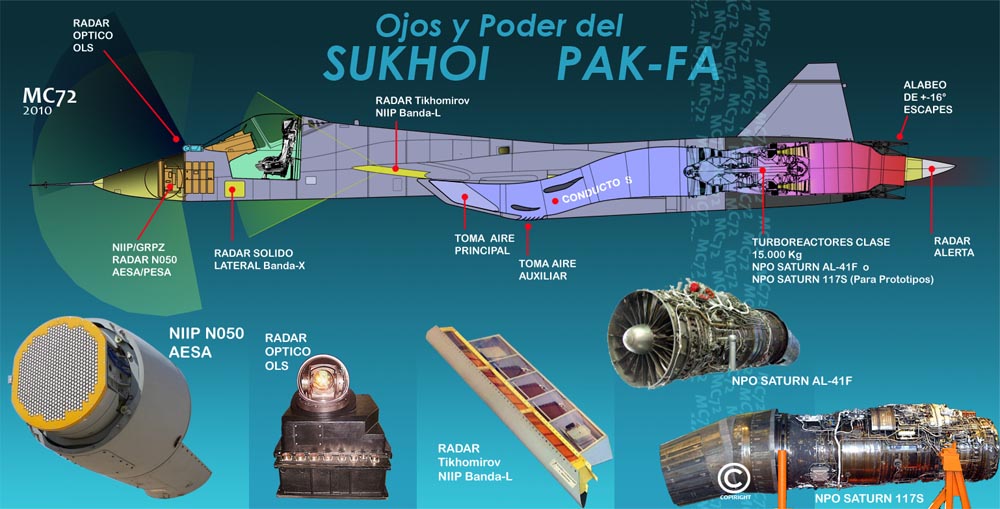

No comments:
Post a Comment